

Part #2 of “Fine motor skills/ development in the early years” series.
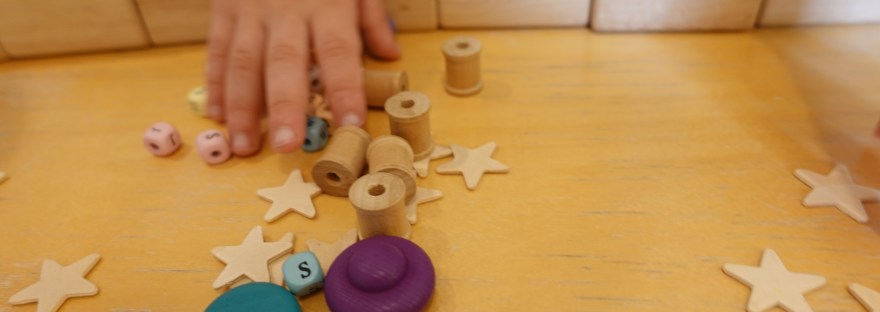
The pictures above (See part #1) show some examples of how the children have used their “loose parts”. One child had an idea that the spools, marbles, and beads were injured creatures and needed bandages, so they used tape to wrap as many as they could. If you are thinking this took some time, yes, it did! When children are interested and committed to their ideas/ projects, they will spend the time they have working to complete as much as they want. We also see some small bags that are filled with “loose parts”. Gathering as many as the tray offered was the priority of one child, and once the bags were filled, this child called the others to come and help unload and set up the dramatic story being created. Fine motor skills are being used without even a second thought, all while engaging in planning, collecting, and managing space and materials. Reaching out and inviting others to join is utilizing their social and communication skills, as well as allowing them to take on a role as “leader” and then a “character” in the dramatic play story. So many decisions go into play, and these are all life skills. Life skills that support fine motor development and growth.
In the above pictures, we also see two examples of transitional symbolic drawing, utilizing fine motor muscles in the hands, fingers, and wrists. The drawing on the far left is a clear and nice example of a child transitioning from scribble to symbolic form. We see the round features of a face, followed by facial characteristics such as eyes, nose, mouth, and hair. The second drawing is done by another child, and the drawing is more advanced, with many details representing the outdoor appearance of a home, complete with background and foreground scenery. This is clearly a symbolic drawing, yet it is also a nice example of a child in transition because, though symbolic, the drawing is still a bit shaky. Shaky or light-pressure drawings are examples of growing confidence. With more time, this child’s shaking light-pressure drawings transformed into strong lines with deep pressure, showing confidence in their work. Wonderful examples of where two children are on their journey of fine motor muscle development. Importantly, it is not just the time these children take to engage in drawing that strengthens their fine motor muscles; it is the many interest areas and things they engage in utilizing their hands, fingers, and wrists that support the healthy growth and development of their fine motor muscles. These experiences are the building blocks young children need for them to be able to eventually print and write, yet they must have these many years of experience building up to that point, and I believe firmly that it should not be rushed or forced.
Magnetic dolls, lacing cards, and block construction all have many things in common, but for this posting, we will focus on the fine motor skills. Magentic dolls may not seem like something that would support young children’s journey to printing/ writing, but this is another useful fine motor form of play that serves many purposes. Magnet dolls seem pretty easy to engage with. Still, when you have witnessed many a young child at various stages of fine motor development trying to dress the dolls, it really is another aspect of how development has stages, and it takes time to get to each one. When children are first navigating magnets, the force of the push and pull is both off-putting and attractive to the child. It is something they want to master, yet in the early stages of fine motor muscle growth, they lack the strength and precision to position the pieces in the correct space and evenly on the doll. As the children grow accustomed to magnets and gain more experience using them, their ability to clothe the dolls with these magnetic pieces becomes smooth and precise. As with all materials in a classroom geared towards open-ended play, the ability to dress magnetic dolls tells me a lot about what the child is interpreting when engaged in this provocation. (Many children dressed the dolls in wild and cheerful preschool fashion!) In regard to fine motor development, the positioning of each magnetic clothing piece demonstrates what the child understands about dressing, what level of control they have over the magnets, and what they are visually representing. When children place the magnet clothes in the correct places on the doll, matching the clothes and including socks and shoes, they are demonstrating their progress in developing their fine motor muscles. They are gaining much-needed skills and interest in printing or writing as they continue with materials like these.
See parts 1,3 & 4


 The Marigold School of Early Learning